54.4.4. QEOV2_ABZ_OUT
54.4.4.1. Overview
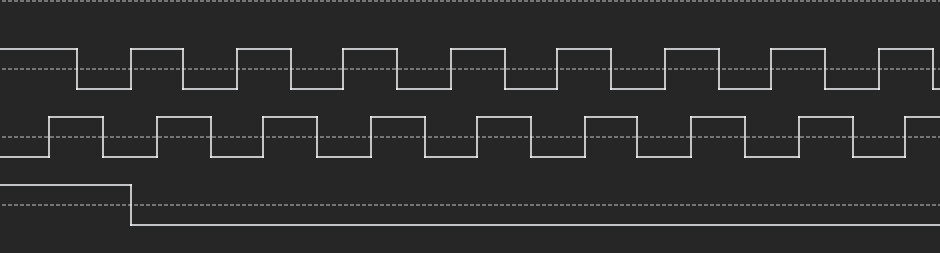
The QEOV2_ABZ_OUT sample project demonstrates the functionality of QEOv2 (Quadrature Encoder Output Version 2) peripheral in generating ABZ quadrature encoder signals based on position information. QEOv2 can receive position information either through software injection or from hardware (such as MMC), and generate standard ABZ quadrature encoder signals based on preset resolution lines, supporting position synchronization for ABZ signal output.
54.4.4.2. Working Process
This example demonstrates two working modes:
Software Position Injection Mode Configuration steps:
Initialize QEO module and configure ABZ signal output mode
Configure ABZ signal generation parameters:
Set encoder resolution (1024 lines/revolution)
Set maximum output frequency (250kHz)
Enable ABZ signal output
Software position injection process:
Calculate position increment value
Enable software position injection
Cyclically inject position values to simulate 2 forward revolutions
Wait for ABZ signals to reach injected position
Reset position to 0 and disable injection
Hardware Position Input Mode
In this example, the hardware generator provides position information to QEO, which generates ABZ signals in real-time based on the received position information.
Configuration steps:
Initialize QEO module with the same ABZ parameters as software mode
Configure hardware position input:
Configure hardware position generator
Enable ABZ signal output
Enable motor system timestamp function
54.4.4.3. Hardware Setting
Use oscilloscope/logic analyzer to observe the quadrature encoder signals on QEO ABZ output pins (Please refer to Pin Description section).
For MCU that does not support MTG peripheral, a QEI peripheral connected to an ABZ encoder (4000 lines) is required to provide hardware position input for testing.
54.4.4.4. Notes
QEO ABZ Signal Uniformity Issues:
When QEO’s position input frequency is greater than 2 times the output ABZ signal frequency (position difference between inputs does not exceed 1/4 line of ABZ), the output maintains uniformity
When QEO’s position input frequency is less than 2 times the output ABZ signal frequency (position difference between inputs exceeds 1/4 line of ABZ), uniformity is maintained by dynamically adjusting the minimum width of ABZ signals
54.4.4.5. Running the Example
When the project runs correctly, you will observe the following:
Serial terminal output:
QEO ABZ example
QEO generate ABZ signal with software inject position
QEO generate ABZ signal with hardware provide position
ABZ Signal Output:
Using oscilloscope/logic analyzer, you can observe the ABZ signal waveforms: - A/B signals: Quadrature square waves with 90-degree phase difference - Output occurs every 16 position points, simulating 2 forward revolutions